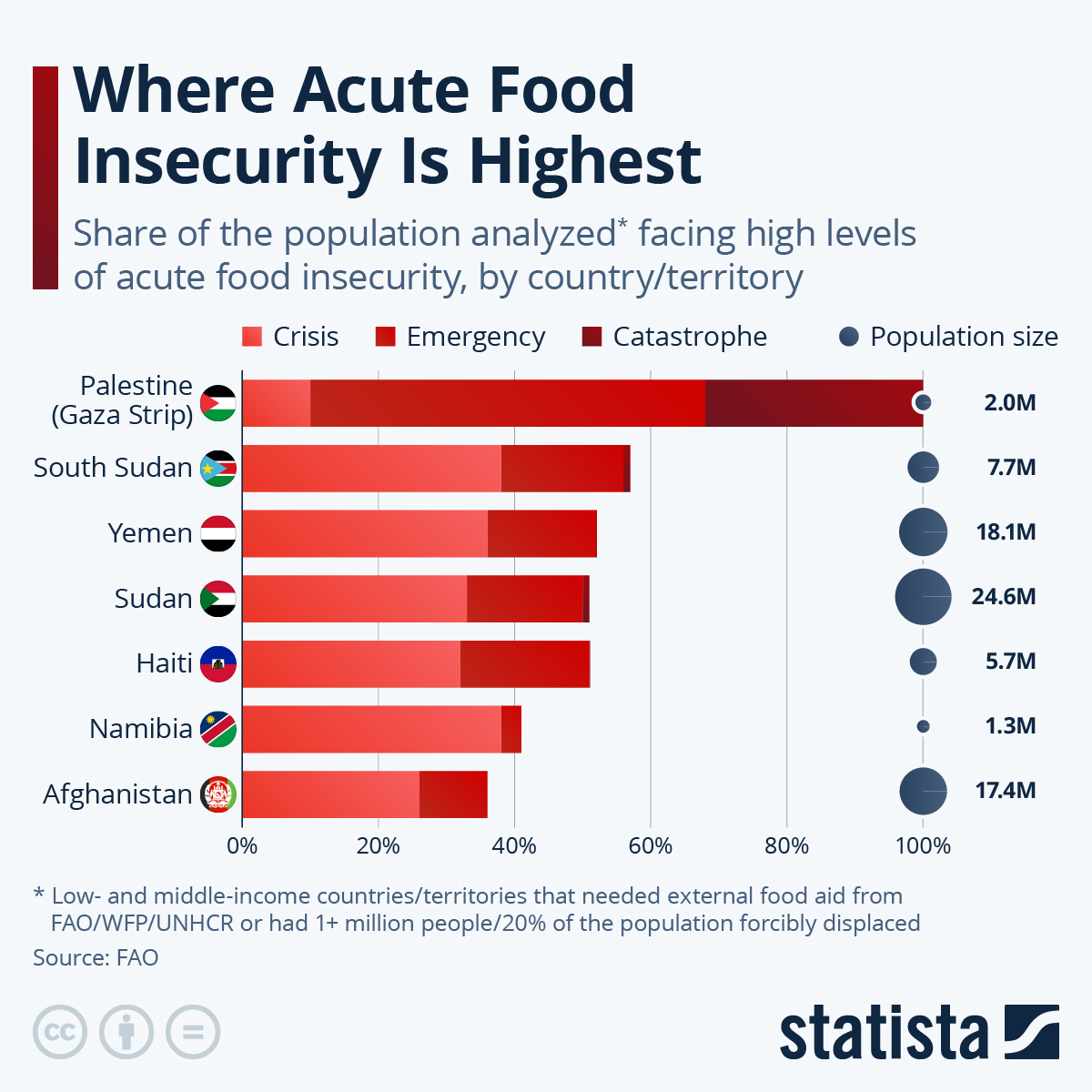
Every single Palestinian living in the Gaza Strip faced food insecurity to a level of crisis or worse in 2025, according to the FAO’s 2026 Global Report on Food Crises. At 100 percent, the territory presented the highest share of people facing high levels of acute food insecurity worldwide. This is the third year in a row for this to be the case. However, in 2025, the situation even deteriorated, with 90 percent of the analyzed population considered to be in IPC Phase 4 and 5 of food insecurity, i.e. a state of emergency and catastrophe, compared with 88 percent in 2024.
The FAO reports that famine was confirmed in Gaza Governorate in mid-August (IPC Phase 5) after Israel ramped up its restrictions on humanitarian assistance following the expiry of a ceasefire. Conditions in North Gaza were likely similar or worse but could not be classified due to a lack of data. While a de-escalation of conflict, a proposed peace plan and improved access to food deliveries are reported to have led to a partial improvement in food security and nutrition conditions between October and December, temporarily offsetting famine classifications, the situation remained critical, with the entire Gaza Strip at risk of famine under a worst-case scenario from December 2025 onwards.
As the following chart shows, another four countries had populations where over 50 percent faced high levels of acute food insecurity. These were South Sudan (57 percent), Yemen (52 percent), Sudan (51 percent) and Haiti (51 percent). At the same time, between 33 and 38 percent of the populations analyzed in Afghanistan, the Central African Republic, Namibia, Zambia and Zimbabwe faced high levels of acute food insecurity last year.
The countries with the highest absolute number of people facing food insecurity in 2025 were Nigeria (30.6 million), the Democratic Republic of the Congo (27.7 million), Sudan (24.6 million), Yemen (18.1 million) and Afghanistan (17.4 million).
This chart’s data is based on the highest or peak estimate of people facing high levels of acute food insecurity during at least one month of 2025, or if not available, the second half of 2024.