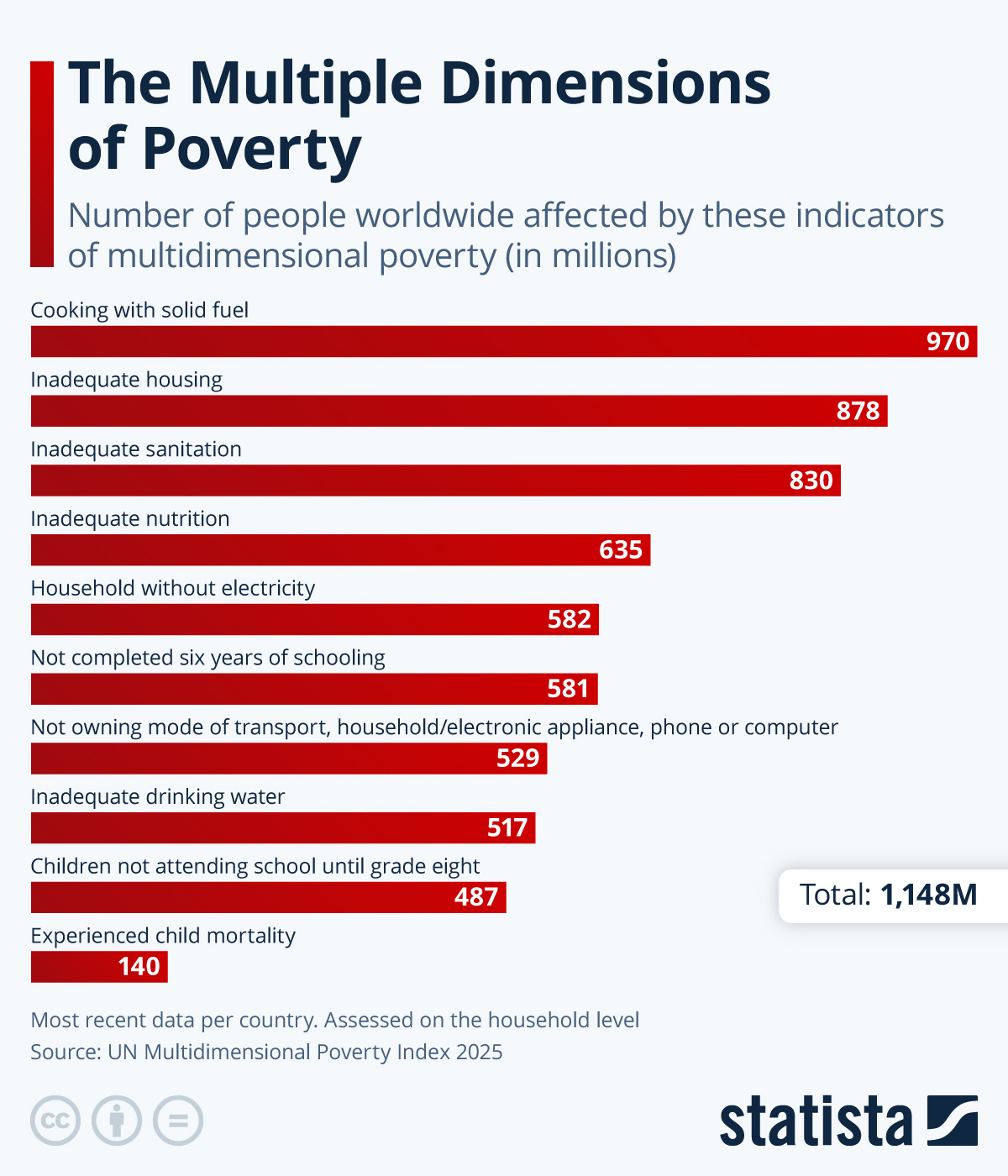
The UN estimated that 18 percent of the world's population lives in acute multidimensional poverty, meaning they are deprived of adequate housing, sanitation, water, food, electricity, basic possessions or education (or a combination of these). As of the latest data published in the 2025 Multidimensional Poverty Index by the United Nations Development Programme and the Oxford Poverty and Human Development Initiative, 1.1 billion people out of 6.3 billion in 109 countries that were analyzed faced severe poverty.
The most common dimension of poverty was lack of access to modern cooking fuels, which can have serious health repercussions due to particle air pollution, affecting 970 million people globally. This was followed by inadequate housing and sanitation facilities, defined as lack of a durable roof, walls and a floor or a private toilet connected to a sewage system or pit, respectively. Between 800 and 900 million people globally did not meet these conditions. More than 635 did not have sufficient nutrition, shown by household members being underweight or stunted, while 582 did not have electricity at home. Around the same number of people lived in households where no member had completed six years of schooling and almost 500 million lived in households where children until grade 8 school age were not attending class.
More than 500 million had no access to a clean, protected drinking water source less than a 30 minute walk away and the same number lacked significant material assets, defined as possessing at least one item between a radio, an animal cart, a phone, a television, a computer, a refrigerator, a bicycle, a motorcycle and a car on the household level. 140 million had a child in the household die within the past five years.
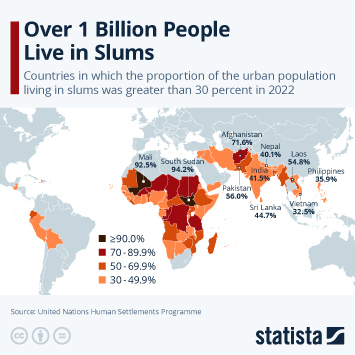
The report found that two thirds of the 1.1 billion people affected by multidimensional poverty live in middle-income countries. Half of those affected are children and almost all were located in Sub-Saharan Africa and South Asia. Overall, the incidence of multidimensional poverty was falling, the report found. The countries most affected were Chad, the Central African Republic, Niger, Burundi and Ethiopia. The most affected nation outside of Sub-Saharan Africa is Afghanistan, followed by Papua New Guinea, Timor-Leste, Haiti, Pakistan and Myanmar. The poorest countries in Europe according to the report are Montenegro and Albania.